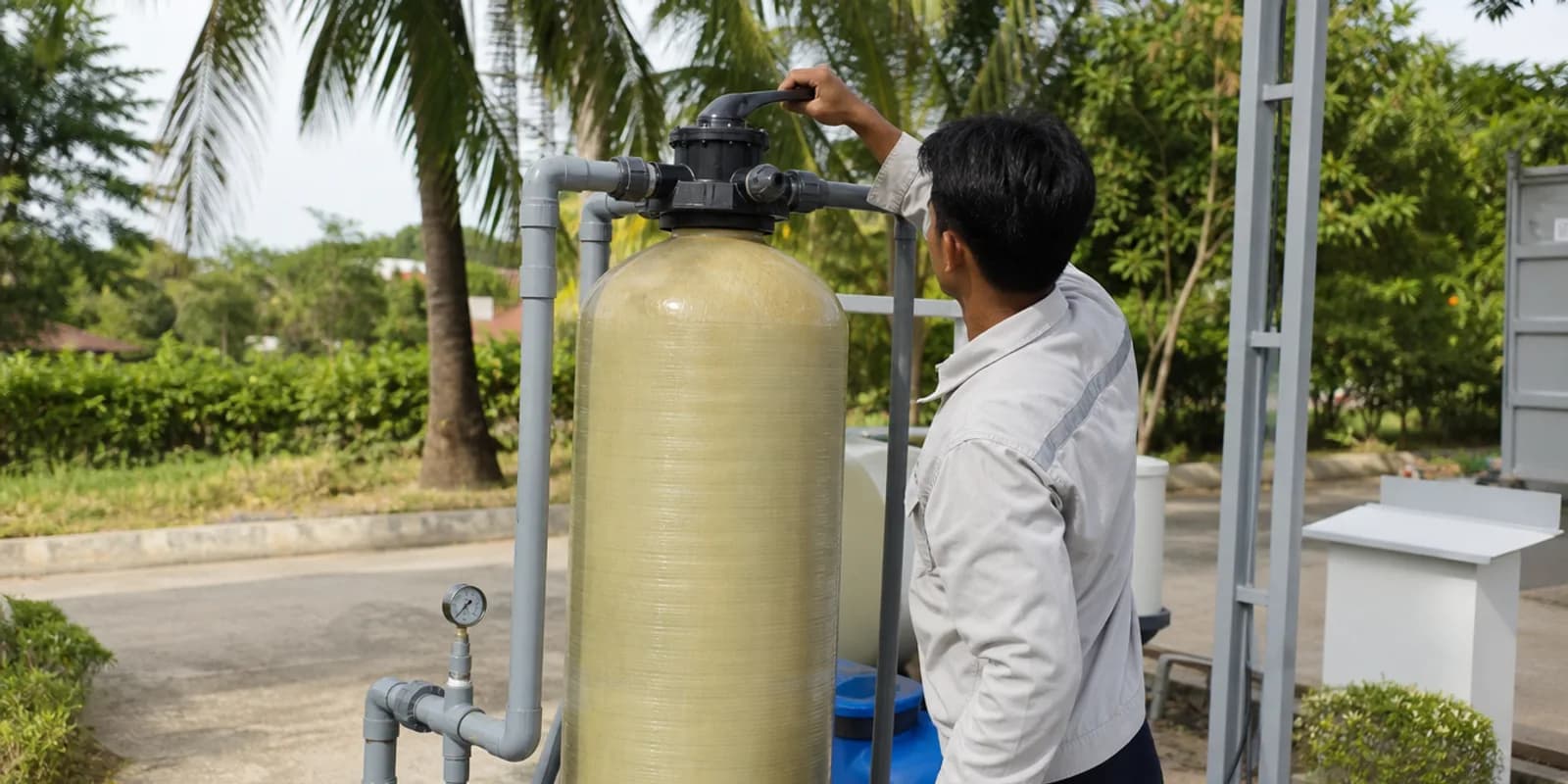
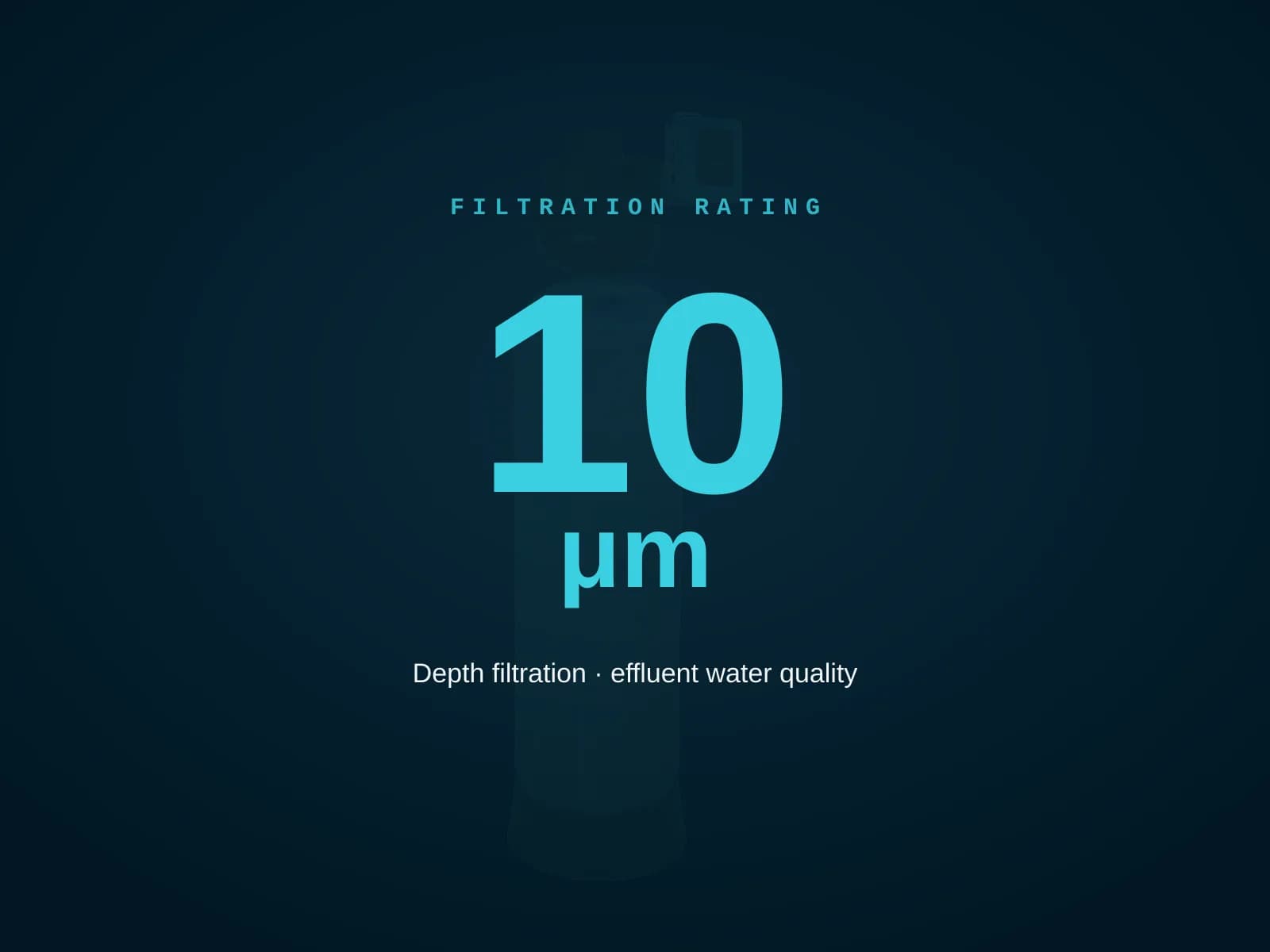
In this article, depth filtration means capturing suspended particles throughout the depth of a media bed instead of at one screening surface, which shows up as effluent quality and, by this article's reasoning, as a pressure loss that climbs over a run (this article's framing, not a cited definition). The Culligan Top Mount (CTM) Depth Filter Family Group is Culligan's commercial and industrial version, described as a top-mounted piston-valve control with an integrated flow meter and a Smart Controller on a media tank whose media is stated by weight.[1] Its brochure carries one particle figure, easily misread: "Depth filters are capable of 10 microns effluent water quality, whereas all other filter types are capable of 40 micron effluent water quality"[1]. That is a maker statement about depth filters, with no published method; the brochure does not define it as a hole size, and does not define all other filter types. Four questions follow, one per section: what decides how long a run meets the statement, what the printed figures assume, what evidence stands behind the statement, and how a site tests it. Sizing sits in the selection guide and a membrane-line configuration in the reference design.
The 10-micron figure is an effluent claim
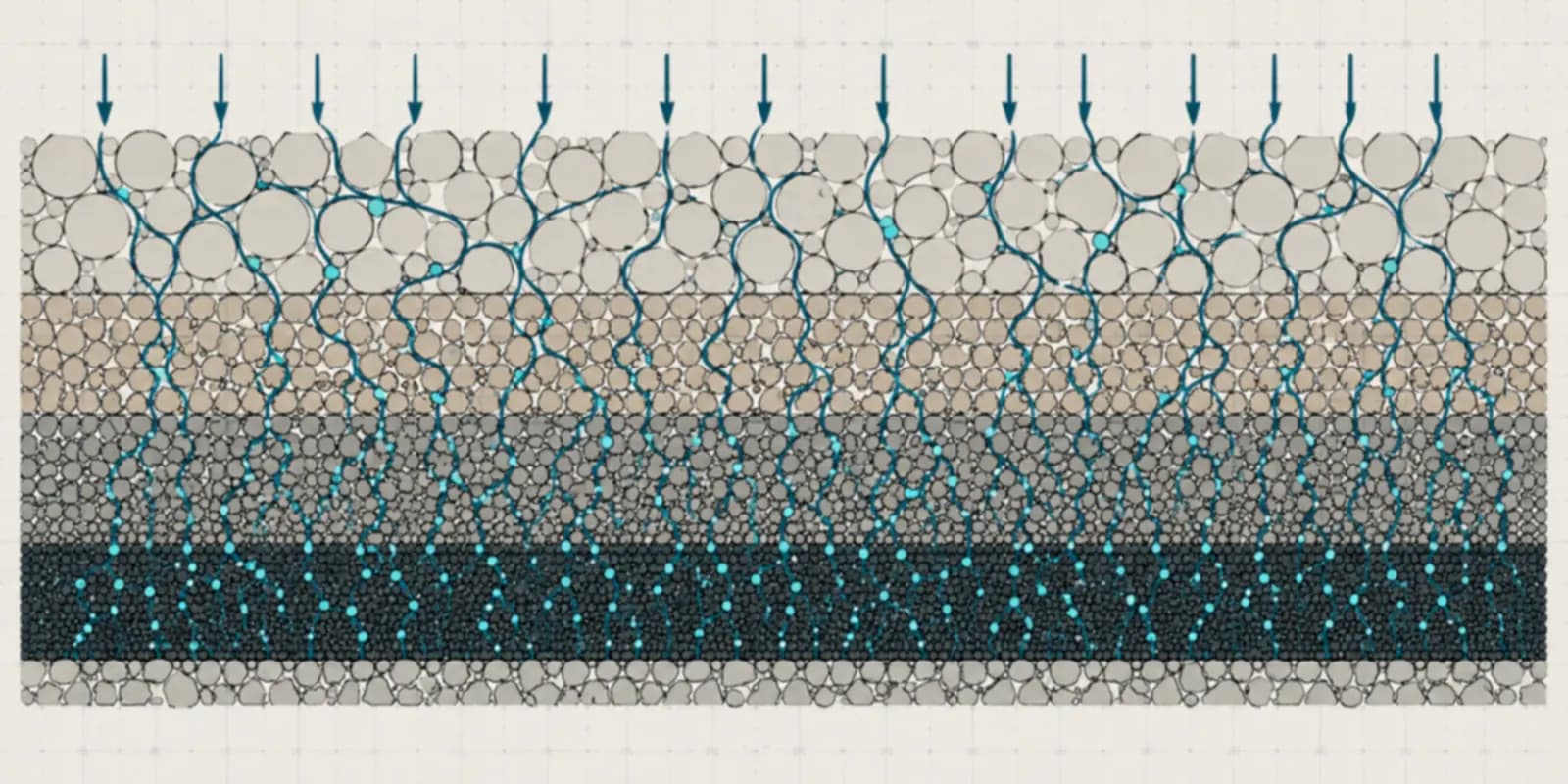
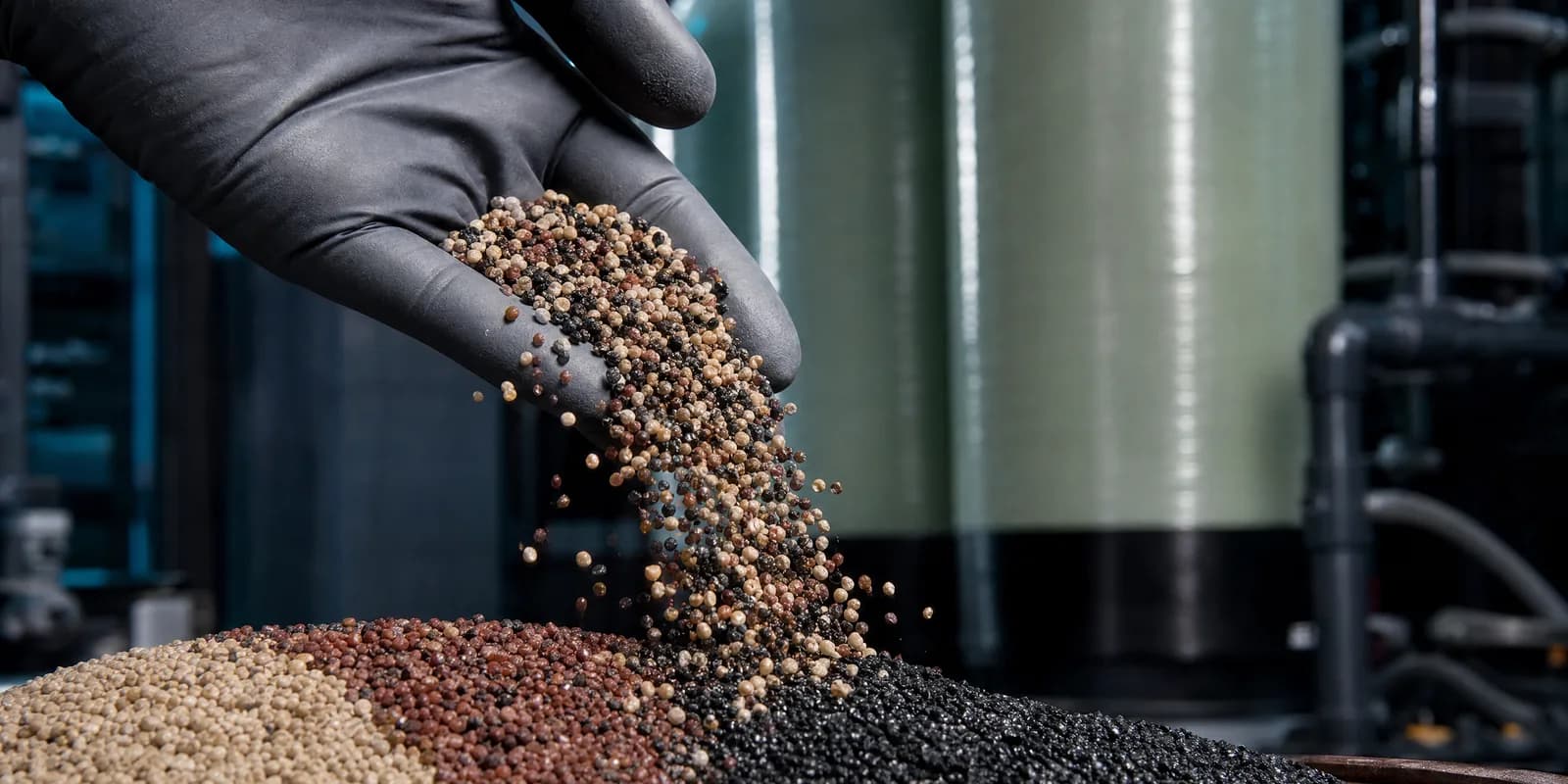
The brochure gives the Depth group's media only as a quantity by weight and names no composition, grain size or depth, so what follows is generic granular-bed reasoning.[1] [ASSUMPTION: the group's media behaves as a granular bed for mechanism reasoning, because Culligan calls it a depth filter and states its media only by weight; valid for mechanism only, invalid for composition, grain size, depth or layering; promoted by Culligan's media specification.] Capture in a granular bed is several acts at once, and only one of them resembles a screen. Veolia's handbook says filtration, "usually considered a simple mechanical process, actually involves the mechanisms of adsorption (physical and chemical), straining, sedimentation, interception, diffusion, and inertial compaction"[3], and a University of Memphis course lists interception, straining, flocculation and sedimentation.[4] Neither source ranks them, so the reading here is this article's own: adsorption and sedimentation do not depend on a pore being smaller than the particle, which is why a single micron figure cannot be read as a hole size.
A run ends by accumulation. The Memphis notes describe deposits building first, since "surface straining and interstitial removal results in accumulation of deposits in the upper portion"[4] of the media, after which "the velocity of water through the remaining voids increases"[4] until "breakthrough occurs, carrying solids out"[4]. Pressure loss across the bed therefore rises as solids accumulate; that step is reasoning from the sequence, consistent with Veolia's handbook treating head loss gauges as essential and describing backwash at a preset head loss.[3] Outlet quality is then a function of position in the run, not a constant of the filter. A low outlet turbidity early in a run may mean only that the feed was clean or the run is far from breakthrough; the check is inlet and outlet readings paired in time across the whole run.
The name depth filter does not in itself say whether the bed is layered, and the brochure does not say either.
Running the bed harder has a printed cost. Culligan's Normal rate class carries "Best quality effluent at specified flow. Lowest pressure loss."[1] and its Peak class "Very good quality effluent at specified flow. Increased pressure loss."[1] No caveat for a rate too low is documented, so none is claimed; the limit here is the one-way cost of pushing the rate, quantified next.
What the rating table assumes
Culligan's per-model figures, with metric values as printed:[1]
| Model | Normal, gpm @ psi drop (lpm @ kPa drop) | Peak, gpm @ psi drop (lpm @ kPa drop) | Backwash flow, gpm (lpm) |
|---|---|---|---|
| CTMDF21 | 24 @ 5 (90.8 @ 34.5) | 36 @ 10 (136.3 @ 69) | 30 (114) |
| CTMDF24 | 32 @ 5 (121 @ 34.5) | 48 @ 9 (182 @ 62) | 48 (182) |
| CTMDF30 | 50 @ 7 (190 @ 48.3) | 74 @ 11 (280 @ 76) | 70 (265) |
| CTMDF36 | 71 @ 10 (269 @ 69) | 107 @ 19 (405 @ 131) | 90 (341) |
- Rate classesSOURCEDNormal 10 gpm/ft2 (24 m3/hr/m2), recommended for suspended solids up to 20 ppm; Peak 15 gpm/ft2 (37 m3/hr/m2), up to 10 ppmsource
- Feed water temperature and inlet pressureSOURCED40-120 °F (4-49 °C); 35-125 psig (240-860 kPa), dynamicsource
- Feed limitsGAP5 NTU, 1 mg/L chlorine, 5 mg/L iron, each footnoted to a media specification that was not retrievedsource
- Backwash trigger pressure loss, duration, volumeGAPNot published in the brochuresource
The header reads gpm @ psi drop, and the notes limit it: "All pressure drop figures are based on new filter media"[1] and a water temperature of 60 °F (15.6 °C). A CTMDF30's 50 gpm (190 lpm) at 7 psi (48.3 kPa) is therefore a clean-bed figure at that temperature, not the loss a loaded bed shows on site. The flow ratings assume the 2 in adapter, and "Specifications shown are for single models."[1] Each family's control valve options are single downflow and multi-tank downflow, so service flow runs down through the bed.[1]
Backwash reverses flow; in generic granular filters the Memphis notes say "Cleaning is accomplished by reversing the flow of water to the filter, or backwashing"[4] and that the "backwash velocity is sufficient to fluidize the bed"[4], and the brochure prints no bed-expansion figure for the CTM. For the CTMDF30, Culligan prints 70 gpm (265 lpm) on a basis of 12-14 gpm/ft² using 50 °F (10 °C) water, and adds in the same note that "A different backwash rate may be required"[1] depending on water temperature, without saying in which direction. The brochure prints no backwash duration, volume, water source or drain destination, and no pressure loss at which backwash starts, so no water budget or run length follows from the brochure. Because feed and filtered water both pass through the top-mounted valve, filtered water must return to the top through an internal path, which the brochure does not describe (reasoning here).
Culligan's introduction describes "an integrated flow meter for highly accurate reporting"[1], without saying whether it totalises or sees backwash flow. The standard features list "Backwash initiation based on either time clock, flow meter or differential pressure inputs"[1], yet differential pressure switch and gauge packages appear only as optional accessories, and the brochure does not say whether a standard unit senses differential pressure without them; no trigger value is given. Culligan's optional Patented Progressive Flow lets the Smart Controller bring further tanks on-line or offline with flow demand; its staging logic and setpoints are unpublished, and tank count is a selection question.[1] The brochure lists a Smart Controller with remote monitoring, "Multiple Alarm Recognitions" that it does not name, and an optional differential pressure switch and gauge package; it lists no water-quality sensor.[1] The questions to ask are which inputs a standard unit reads and where the trigger is set.
[ASSUMPTION: an ASEAN supply is about 30 °C (86 °F); valid for a supply inside Culligan's printed 4-49 °C feed range, invalid for colder or hotter supplies; promoted by a Culligan temperature correction.] That temperature sits inside the feed range but outside both bases, 60 °F (15.6 °C) for pressure drop and 50 °F (10 °C) for backwash, and the brochure prints no correction for either, so the printed loss and backwash rate are reference points, not site values. A site clean-bed loss that departs from the table therefore cannot be read as a fault until temperature, flow, adapter size and media age are logged beside it. The feed limits (5 NTU, 1 mg/L chlorine, 5 mg/L iron) carry the note "See media specification for details"[1], a document not seen here.
Normal against Peak is where the figures couple. Moving a CTMDF30 from its Normal 50 gpm (190 lpm) to its Peak 74 gpm (280 lpm) adds 24 gpm, a rise of 48%, while the printed loss goes from 7 to 11 psi (48.3 to 76 kPa), up 57%, and Culligan's recommended suspended-solids load falls from up to 20 ppm to up to 10 ppm.[1] Only two points are printed per model, so no curve or exponent lies between them.
The solids reaching the bed are flow times concentration, derived here. At Normal, 50 gpm is 11,356 L/h and 20 mg/L brings 227 g/h; at Peak, 74 gpm is 16,807 L/h and 10 mg/L brings 168 g/h. [ASSUMPTION: ppm of suspended solids reads as mg/L; valid for dilute water near 1 kg/L; used only for these two mass rates.] The ratio, 0.74, needs no such assumption: at their own recommended limits, solids arriving at the bed at Peak are 0.74 of those at Normal. Without a published solids-holding capacity, no run length follows.
Peak is the highest printed rate and no minimum flow is published, so Normal and Peak are two rated points, not an operating range. At lower flow less solids reach the bed per hour by the same identity, so if the feed concentration is constant, a time-clock trigger set on design flow would backwash earlier than the load requires (reasoning; the brochure describes no trigger mechanism). The flow-meter and differential-pressure triggers are listed but not described. A short run may therefore have causes outside the rate class: the initiation basis, feed solids or upstream conditioning.
The 10-micron evidence on file is the brochure
The evidence on file for the CTM Depth Filter is a maker's brochure, Part No. 39011 dated August 2017 (8/17), and no independent laboratory report, field record or removal-test result was retrieved for the CTMDF21 to CTMDF36. The 10-micron sentence and every figure above sit at the maker tier: they show what Culligan claims and at which basis, not what a unit delivers on a buyer's water. The brochure adds its own condition: "Operational, maintenance and replacement requirements are essential for this product to perform as advertised."[1]
The brochure states that "The CTM valve and system also carry certification for testing and passing the highest drinking water standards"[1] and prints a badge stating tested and certified by WQA to NSF/ANSI 61 and 372, with no group named and the Greensand/Cullsorb filters excluded as not tested or certified by WQA[1]; it does not say what removal claim, if any, was tested. A search of NSF's Drinking Water Treatment Units listing for Culligan, run on 2026-09-07, returned entries under NSF/ANSI 42 and 55 and CSA B483.1 and no CTM or depth-filter entry, and WQA's own database was not successfully searched here.[2] Neither result confirms or refutes the badge, and the brochure states no particle-removal claim under it. The brochure's example applications include "RO, Softener, and DI Pretreatment"[1], a whole-brochure list of stated uses, not a test.
A rate class is meaningful only with its media, and the brochure gives the CTM media only by weight, with the 10 and 15 gpm/ft² (24 and 37 m³/hr/m²) classes printed against it.[1]
One site reading stays ambiguous: a pressure loss that does not return to its commissioning baseline after backwash. The backwash may be wrong for the actual temperature or have failed to restore the bed, or the fouling may not be removable by backwash; UC ANR reports biological matting in sand filters for microirrigation, a different class of equipment, so that last alternative is reasoning here.[5] The check is to compare post-backwash clean-bed loss run to run at the same flow and temperature.
How to prove a CTM on site
A CTM figure is reproducible only if it carries its conditions, and they differ by claim. An effluent-quality claim needs a particle basis (turbidity in NTU, particle counts by size, or removal at a stated size), the method, the feed measured, the rate class and the point in the run, because NTU and suspended solids in mg/L relate only through paired sampling at the site. A pressure-loss claim needs new or loaded media, water temperature, flow, adapter size and both taps on one gauge. Backwash adequacy needs the rate per square foot at the actual temperature, duration, volume, and water source and destination, none of which the brochure gives.
The media is the first request. The brochure ties its feed limits to a media specification,[1] so that document is the one to ask for; it should state composition, effective size, uniformity coefficient and bed depth, though the brochure does not say what it contains. Starke, a media maker, defines effective size as the particle diameter at which 10% of the media sample by weight is finer.[6] Backwash water is measured at the drain, not on the built-in meter, because the brochure does not say that meter sees backwash flow. [ASSUMPTION: a timed collection or totalising meter on the drain line gives backwash volume independently; valid where the drain is accessible; promoted by a documented backwash-volume figure from Culligan.]
For a CTMDF30 the printed envelope holds as 50 gpm (190 lpm) at 7 psi at Normal and 74 gpm (280 lpm) at 11 psi at Peak, on new media, 60 °F water and the 2 in adapter, for a single model, with suspended solids up to 20 ppm at Normal and up to 10 ppm at Peak, and as a 70 gpm (265 lpm) backwash at 12-14 gpm/ft² with 50 °F water.[1] It is not shown to hold for a loaded bed, a 30 °C supply or a multi-tank arrangement, Culligan says flow may be slightly lower with the 1.5 in adapter,[1] and it says nothing about what the 10-micron statement means in NTU, counts or removal; whether a CTMDF30 fits a given demand is the selection guide's question.
Before any figure is relied on, the data to send is the feed's turbidity and suspended solids from paired sampling, the water temperature range, flow profile, inlet pressure, adapter size and tank count. The terms to agree in writing are the particle basis and method behind the 10-micron statement, the temperature, rate class and run point at which it is to be met, the backwash rate and its temperature basis, the pressure loss at which backwash starts and who sets it, and the media specification.
Culligan Top Mount (CTM) Depth Filter
Sources
- [1]Culligan — The Culligan Top Mount Series Water Filter System brochure (Part No. 39011, 8/17) — primary CTM datasheet
- [2]NSF International — Certified Product Listing search, company name CULLIGAN (searched 2026-09-07)
- [3]Veolia Water Technologies — Water Handbook, Chapter 6, Filtration
- [4]University of Memphis, CIVL 1101 course notes — Introduction to Water Filtration
- [5]UC Agriculture & Natural Resources — Maintenance of Microirrigation Systems: Sand Media Filters (different product class)
- [6]Starke Filter Media — Effective Size vs Uniformity Coefficient in Filter Media: Complete Engineering Guide